Pigeon Silhouette Vector Design: A Practical Guide for Digital Creators
In the landscape of digital graphic design, specific motifs often serve as foundational elements for broader creative projects. Among these, the Pigeon Silhouette Vector Design has emerged as a versatile asset for illustrators, print-on-demand entrepreneurs, and branding specialists. This article provides an objective evaluation of this design category, exploring its technical specifications, practical applications, and the considerations necessary for selecting the right assets for your workflow.
Understanding the Asset Class
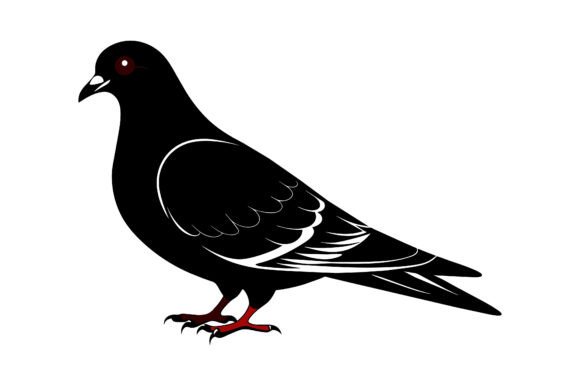
A pigeon silhouette vector design is a graphical representation of a pigeon reduced to its essential outline, constructed using mathematical paths rather than pixels. Unlike raster images (such as JPEGs or PNGs), which are composed of fixed grids of colored squares, vector graphics rely on points, lines, and curves defined by algorithms. This fundamental difference allows the Pigeon Silhouette Vector Design to be scaled infinitely without loss of quality, making it suitable for everything from small social media avatars to large-scale billboard prints.
The "silhouette" aspect refers to the solid black or single-color shape that represents the subject against a contrasting background. By stripping away internal details like feathers or eye color, the design emphasizes form and posture. This minimalist approach makes the imagery highly adaptable, allowing designers to overlay text, integrate it into complex compositions, or recolor it to match specific brand palettes without visual clutter.
Technical Advantages and File Formats
When evaluating vector assets, the file format is a critical determinant of usability. High-quality providers typically offer the Pigeon Silhouette Vector Design in multiple formats to accommodate different software ecosystems. Understanding these formats helps users make informed purchasing decisions based on their technical capabilities.
- .AI (Adobe Illustrator): The native format for Adobe Illustrator. It preserves all editable layers, anchor points, and effects. This is ideal for professional designers who need full control over the path data.
- .EPS (Encapsulated PostScript): A widely compatible vector format used in professional printing and legacy design software. It ensures that the design remains scalable across various platforms, even if the user does not have access to Adobe products.
- .SVG (Scalable Vector Graphics): An XML-based vector image format for two-dimensional graphics. SVG is essential for web design, as it loads quickly, scales responsively on mobile devices, and can be manipulated with CSS and JavaScript.
- .DXF (Drawing Exchange Format): Primarily used in computer-aided design (CAD) and laser cutting. If you intend to use the pigeon silhouette for physical fabrication, such as cutting wood, acrylic, or metal, the DXF format is often required by manufacturing machinery.
- .PNG: While technically a raster format, high-resolution PNGs with transparent backgrounds are included for immediate use in non-vector software or for quick previews. However, they do not offer the infinite scalability of the vector files.
The inclusion of 100 vector shapes within a single pack suggests a comprehensive collection, potentially offering variations in pose, angle, and detail density. This volume allows for diverse applications, ensuring that a designer is not limited to a single static image but can choose the most appropriate composition for their specific layout.
Practical Applications and Use Cases
The versatility of the Pigeon Silhouette Vector Design makes it suitable for a wide array of commercial and personal projects. Its adaptability is particularly evident in the following areas:
Apparel and Merchandise
For t-shirt designers, the silhouette offers a clean, bold graphic that stands out on both light and dark fabrics. Because the design is vector-based, it can be easily resized to fit chest prints, back prints, or sleeve accents. The ability to customize colors means the same asset can be used for summer collections (bright colors) and winter collections (muted tones) without needing to recreate the artwork.
Branding and Identity
Businesses looking to create a mascot or logo element may find value in pigeon silhouettes, particularly for brands associated with urban environments, communication, or freedom. The simplicity of the silhouette ensures legibility at small sizes, such as on business cards or app icons, while maintaining impact at larger scales.
Digital Illustration and Publishing
Book covers, flyers, and editorial illustrations often require striking imagery that conveys mood quickly. A pigeon silhouette can symbolize peace, urban life, or observation. Designers can layer multiple silhouettes to create depth or combine them with typography to create balanced compositions.
Evaluating Tradeoffs and Considerations
While vector designs offer significant advantages, there are tradeoffs to consider when integrating them into a project.
Customization Complexity
Although the designs are described as "easily customizable," the level of effort required depends on the user’s proficiency with vector editing software. Adjusting anchor points, merging paths, or changing the color palette requires familiarity with tools like Adobe Illustrator or Inkscape. For users lacking these skills, the customization process may present a steep learning curve.
Originality vs. Stock Assets
Vector silhouettes are common stock assets. Using a pre-made pigeon silhouette may result in a design that looks similar to other works found online. To avoid generic aesthetics, designers must invest time in combining the silhouette with unique typography, textures, or background elements. The value lies not just in the asset itself, but in how it is integrated into a broader creative vision.
Software Compatibility
Not all design software supports every vector format. Users working primarily in Canva or Procreate may face limitations when trying to edit .AI or .EPS files directly. In such cases, converting the file to a compatible format or using the provided PNG versions becomes necessary, though this sacrifices some scalability.
Decision-Making Framework
To determine if the Pigeon Silhouette Vector Design aligns with your needs, consider the following questions:
- What is the end medium? If you are printing on fabric or cutting materials, prioritize packages that include DXF and high-resolution PNGs alongside vectors. For web-only projects, SVG is sufficient.
- Do you need scalability? If your project involves large-format printing, vector formats (.AI, .EPS, .SVG) are mandatory. Raster images will pixelate and degrade quality.
- Is customization required? If you need to alter the shape significantly, ensure the source files are provided in editable vector formats. If you only need to change colors, even simpler formats may suffice.
- What is your budget versus time? Purchasing a pre-made vector pack saves hours of drawing time. However, if originality is paramount, commissioning a custom illustration might be a better long-term investment.
Conclusion
The Pigeon Silhouette Vector Design represents a functional and efficient resource for creators seeking to incorporate avian motifs into their work. Its primary strength lies in its technical flexibility—offering scalability, ease of color modification, and compatibility across various industries from apparel to digital media. By understanding the file formats available and the potential limitations regarding originality and software requirements, designers can make informed decisions about whether to integrate these assets into their projects. Whether used as a standalone graphic or as part of a larger composition, these vector silhouettes provide a reliable foundation for high-quality visual communication.